Sunday, 20 March 2011

Angklung

The Angklung is a musical instrument of Javanese origin, made of bamboo. The word Angklung originated from two words angka and lung. Angka means "tone", and lung means "broken" or "lost". Angklung then means "incomplete tone".
The Angklung in its "crude" form dates back to ancient times, long before the acceptance of the gamelan orchestra, which was introduced into Indonesia with the arrival of Hindu culture. When attractive and more functional Western instruments began pouring in from Europe, interest in the native bamboo instrument waned. However, through the passage of time, the Angklung received a more international attention and became popular throughout Southeast Asia.

 The smaller angklungs, each corresponding to individual notes, which are usually played by the girls as it's lighter :p

 The bigger angklung, which comprise of notes from one chord, are played by the guys as it's heavier :p

Angklung is a musical instrument consisting of two or more bamboo tubes of differing lengths attached to a bamboo frame. The tubes are carved so that they have a resonant pitch when struck, which corresponds to a specific octave. An angklung player holds the instrument in one hand and shakes it with the other, causing a rapidly repeating note to sound. A melody is performed by providing as many angklungs and players as required by the different pitches of the tube.

The Angklung group will be performing ‘Naik-Naik Ke Puncak Gunung’ and ‘Burung Kakak Tua’, which are children songs from Indonesia. During their rehearsals, they were first guided by Ibu Eli and Ibu Yuke, while the student conductor takes over after that. Though the students have minimal practice time of only 3 practice sessions, they were already able to play the whole song out smoothly by the 2nd practice! These students do indeed have noticeable talents:D
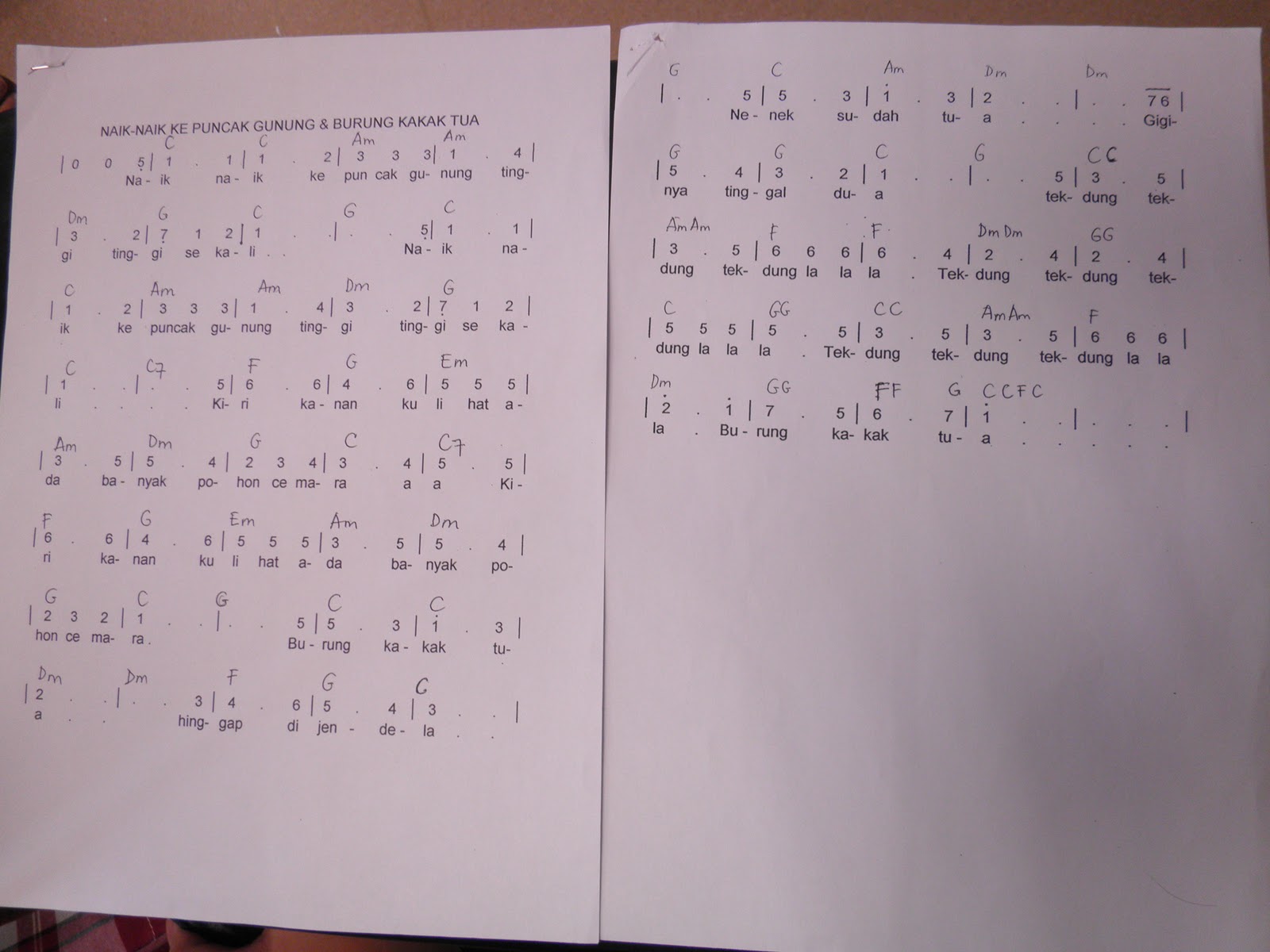

 Music score

  Students playing the song under the guidance of Ibu Eli & Ibu Yuke
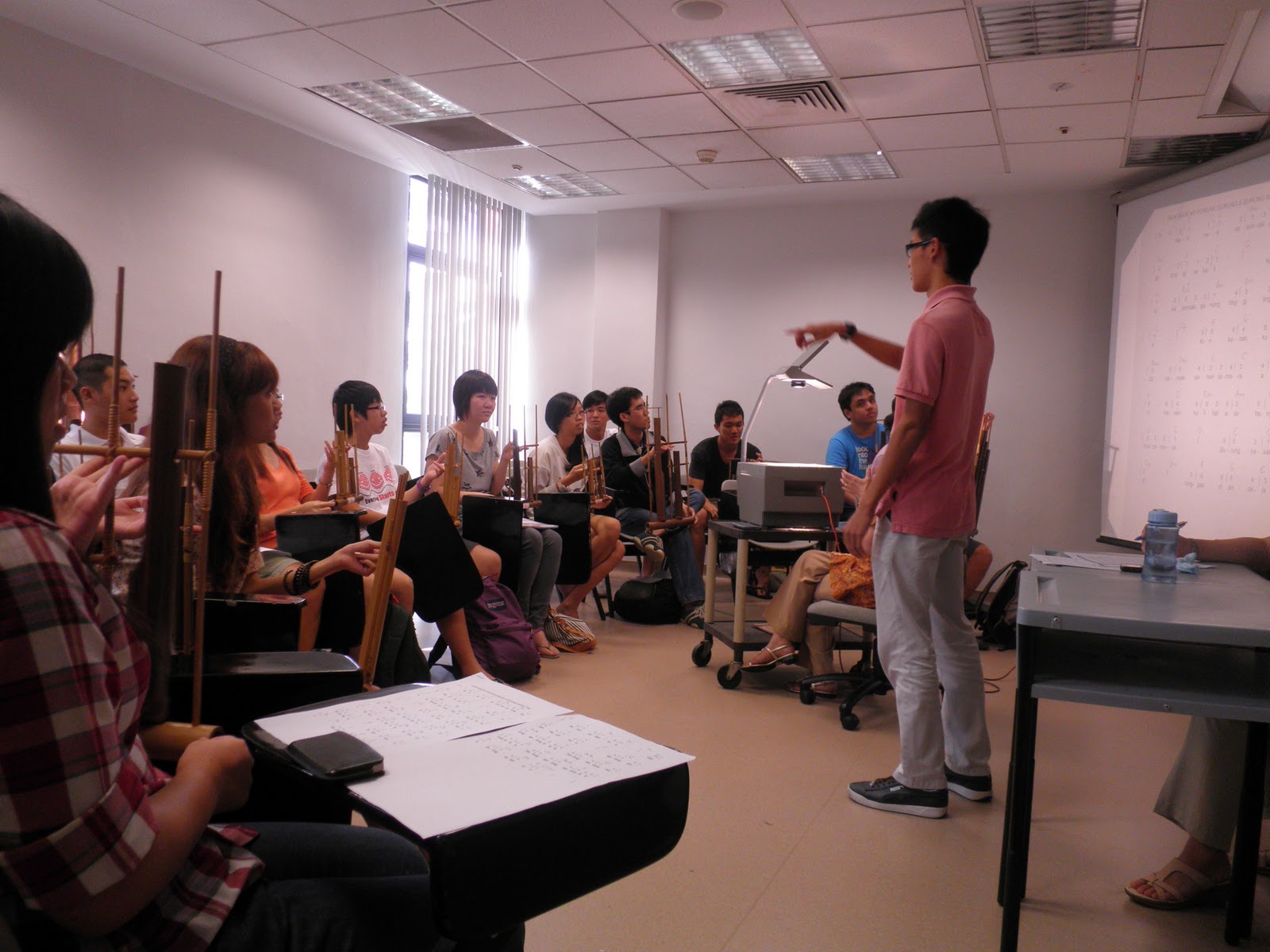
The student conductor takes over and facilitates the practice

A trial run of the song without looking at the music score, under the guidance of the student conductor

In the midst of the practice, problems they face include the ability to hold the notes for the right amount of time and keeping in beat with the conductor. Though there were some mistakes along the way, they were able to work together and rectify it, thereby improving each practice to a higher standard. As commented by some students, learning to play the instrument and knowing when to play their note by reading the score was easy. However, the most challenging issue they face was the memorisation of the music score, which will in turn affect the timing they have to play their respective notes, as they had to perform without it.

Everyone enjoyed the process of making music and also achieved a sense of accomplishment as the ability to perform the song smoothly requires great teamwork and coordination. Be sure to lookout for their amazing performance on Bahasa Indonesia I project day on 25 March 2011 and be prepared to sway along with their captivating music!

Saturday, 19 March 2011

Maluku Dance

The Maluku Dance that this team is performing originates from Maluku, which is around the Eastern part of Indonesia. This dance is sometimes called the "friendship dance" as it signifies friendship among all the dancers participating. 


Not only does it require a high level of co-ordination and focus, it also requires a great deal of energy! Most of the dance revolves around jumping in and out of the bamboo formation according to the beat of the music, which really tests the concentration of the dancers!


Interview with 2 dancers during their break!
Benjamin and Jade from FASS:

How long did you take to learn this dance?
Benjamin: This is only the third time we're meeting to rehearse. And this is the best rehearsal so far! We're still in the process of learning it.

What have you learnt from this experience?
Jade: How to co-ordinate! Even when handling the bamboo poles, you have to be very careful not to hit other people. You have to really focus on what's happening. We've learnt teamwork as well!
Benjamin: In this dance, you must follow the beats very carefully, you must have very good co-ordination.

What are the difficulties you have faced in learning the dance and in these rehearsals?
Benjamin: Remembering the steps and following the beat! As we only have 1 hour for every session, we sometimes forget what we have learnt in the previous lessons.

Here's a video showing part of the dance! Be sure not to miss this at the event!

Although the rehearsal session was only the third of its series, the dancers have already shown their hard work and perseverance in learning, through the highly co-ordinated steps in their practices. It was truly a joy to be able to report on this performance!

Saman Dance

Saman Dance is an Indonesian dance that adopted dancing styles from Arab and Persia. It is well-known as “Dance of a Thousand Hands”. 

Saman Dance was named after Sheikh Saman Aceh, a cleric in XIV century AD, from the central highlands. In the past, Saman dances were performed during important Indonesian traditional events, such as Kelahiran Nabi Muhammad SAW (birth of Muhammad SAW). Over the years, it has evolved to serve not only as a performance but also a form of entertainment enjoyed by the old and young. 

The uniqueness lies in the cohesion of the movement, where dancers move in unison to the music. During the course of the project, Ibu Yenti and Ibu Lucy taught the students how to coordinate various hand clapping, body and head movements. To facilitate their learning, a video was played and the students were required to follow the dance movements. 


Students were required to kneel and coordinate their hand movements according to the increasing tempo.


This part of the dance is tough due to alternate hand movements!


Alot of coordination is required :)


Initially, some found it difficult to coordinate as the tempo increases. However, with numerous hard work and practices, they begun to familiarise themselves with the various hand movements and coordination and thoroughly enjoyed the dance.


After practicing, students would view their recorded performance and learn from their mistake.
Practice makes perfect :)


Drama

The drama team wracked their brains for inspiration to create an interesting and original storyline. Besides having to keep in mind the need to amuse their audience, the team also needed to keep their plot simple so as to be easily understood by those who have just started learning Bahasa Indonesia. As such, they came up with a script in Bahasa Indonesia peppered with English terms. The cast, being new to Bahasa Indonesia as well, had a hard time memorising their scripts.

The practice on the 17th march was the first time the team met to act out the script they prepared. The practice was filled with laughter, with the cast attempting exaggerated gestures and dramatic tones. Though none had theoretical background and all were uncomfortable with such dramatic actions, they still tried their best. Every suggestion to make the show more interesting or funny was tried out even though it was ‘embarrassing’ to some. The team, which started out shy and nervous, became more confident and expressive with practice. On top of that, the drama team had to come up with their own props, background sets and sound effects! Everybody in the team contributed regardless of whether or not they were from the props team. Such teamwork and effort committed to making this show a success is definitely praise-worthy.

having fun in practice!
Paying attention to suggestions given by a fellow member.

Drama in action!
Be sure to catch their rendition of a Cinderella story with a twist! Look forward to the amazing creativity and comical acting of this Fun Drama Coming Soon!

Friday, 18 March 2011

Batik (The Art of Cloth-Printing)

“What is batik?” Some students had signed up for batik but they did not even know what batik was. However, by the end of the activity led by Ibu Fanny, the students had learnt to appreciate the batik and even made their own batiks.
Batik is Indonesia’s most highly developed art form. It is the Indonesian art of cloth-printing and it uses the traditional manual wax-resistant dyeing technique.

During the activity, the students learnt that natural materials such as cotton are usually used for the cloth as these materials are better in absorbing the wax that is used in the dye process and that the fabrics must have high thread count so as to maintain the intricate designs of batik.

The first process was designing. Students selected the designs for their batik based on templates and picture given by Ibu Fanny while others came up with their own designs. Next, they outlined the pattern onto the cloth. This is traditionally done with charcoal or graphite.

The second process was waxing. Wax is applied to the cloth over the areas of the design that is meant to remain the original colour of the cloth.

The third process was painting the designs on the cloth.

Design (1)

Design (2)

Design (3)

The final process was to iron the pieces of cloth until the cloth are completely ‘clean’ which is to remove the moisture and wax completely.


Ibu Fanny demonstrating

Happy students with their beautiful batik


At the end of the activity, the students framed up their batik and prepared to display it on project day. So do look out for them on project day! While you are admiring them, remember that a lot of effort is put into that piece of art :)  

Memasak Di Rumah Ibu Yuke

On 18th March 2011, 9 students hungry for knowledge and food gathered at Ibu Yuke’s house. These students learnt how to make two traditional Indonesian desserts, Klepon (which is known to many of us as Onde-onde) and Agar-Agar Gula Merah. All 9 of them were eager to try out these recipes and needless to say, to taste them!

First, they made Klepon! 


 Cutting up Gula Melaka finely for the filling of the Klepon 


Mixing all the ingredients to form the dough 


Filling up the dough with the Gula Melaka 


And rolling them into small balls 


Boiling them


Covering them with grated coconut 


YAY! :) 


Happy students with their completed Klepon! 

Next, they made Agar-Agar Gula Merah 


Ingredients for the Agar-Agar Gula Merah 


Mix them all together and bring to a boil 


Pour the mixture into a mould and leave to cool, then refrigerate 


Taking out the jelly from the mould 


The jelly naturally separates into 2 layers! 


Cutting it up into pieces 


Yay! :) 


9 happy students with their masterpieces. All eager to tuck in! 

The 2 hours of cooking was filled with joy and laughter. And many of them learnt that it is actually very simple to make these 2 desserts and it is a lot cheaper to make it themselves rather than buying it. And i am sure that many of them will continue making these for their families and friends.  

Memasak Di Rumah Ibu Agnes


 On the morning of 17/03/11, a team of 11 budding chefs gathered at Ibu Agnes’ house to learn the recipes of 2 traditional Indonesian dishes, Talam Ebi and Panada. The dishes were relatively simple but very delicious.  These students came in with no prior knowledge in the area of Indonesian cuisine. However I must say that they left with not only the skills to whip up traditional dishes with finesse but also the passion and interest in the Indonesian culture. Much learning took place in the short span of 2 hours and words alone cannot do justice to the vividly enriching cooking session. Below are just a few of the more sensational moments captured during the session.  


The humble ingredients that greeted the students as they entered the kitchen.


The first dish of the day was Talam Ebi. A fragrant coconut milk kueh dish


Boiling the milk may look menial but the task was rather arduous. A lot of effort was put in to stir gently and evenly.


The chefs were also very lucky that Ibu’s son, Matthew, was hyperactive in all the right areas :)

Coconut milk was left to steam and after a good 30 min, the dish was done. Garnishing was separate of course.


The second dish of the day was Panada- a traditional seafood curry puff dish


Mix and mix and mix!


Ibu Agnes teaching the pack the art of making the perfect curry puff.


The culmination of 2 hours of hard work, patience and determination. Bon Appetite!
In retrospect, the students found the session to be a fruitful and wondrous one. Even though the ingredients were simple and by no means fancy, the students learned that tasty dishes could still be made.